





Key Takeaways
- Understanding that breathing is beyond just the lungs and diaphragm. Our postural muscle play a major role in our breathing mechanics.
- A breakdown of the key muscles that are used during correct breathing activation and technique.
- The advantages of using a combination of stretching and Spidertech Kinesiology tape to aid in slouching and poor posture.
The silhouette of a hooded sweater, rounded shoulders, and forward head tilt could describe nearly half the population on any given Sunday. Somehow, this ubiquitous figure navigates crowded walkways while fully attending to their mobile messages.
Yet, unknown to most, this common posture can influence how deeply we breathe. Research now supports that this new adoption can lead to musculoskeletal pain. The head tilt and rounded shoulders, when held for extended periods, parallel the extreme posture requirements of elite performers, such as musicians and athletes.
In most cases, breathing is top of mind once our life-sustaining elixir is short in supply. Whether tooting a horn, running, or training, attention can become momentarily diverted to deeper and stronger inhales and exhales when oxygen begins to run low, so breathing strategies rank high for many musicians and athletes.
Only as we push ourselves near our cardiovascular limits does breathing become an issue during sports. Regardless of the magnitude you wish to improve your performance, breathing strategies matter, which means your posture matters, too.

Beyond The Diaphragm, How Postural Muscles Affect Breathing
High school and Anatomy 101 classes emphasize the importance of the diaphragm. The sizeable dome-shaped muscle is responsible for expanding the chest cavity and allowing our lungs to fill with air. However, many other muscles help make breathing easy.
Among them are intercostal muscles, the tiny muscles located between the ribs, and in coordination with the diaphragm, the Levatores Costarum and Serratus Posterior Superior help to elevate the ribs during inhale. In contrast, the Serratus Posterior Inferior helps to lower the ribs downwards during exhale.
Yet, the musculature we typically associate with our posture contributes to our ability to breathe, such as:
1. Scalene muscles, located in the neck
2. Sternocleidomastoid muscles, located in the neck
3. Abdominal muscles
4. Trapezius, a large superficial back muscle
5. Serratus Anterior
Then there are the pectoralis (minor and major) muscles. The ones who get a slight beating when we attempt to imitate Tarzen pounding his chest.
It is the origins and insertion points of the pectoralis muscles that are particularly interesting when it comes to posture. These two muscles have origins and insertion points connecting our rib cages with the scapula (shoulder blade) and the upper arm (humerus) just below the shoulder joint.
So, when we slouch, hunch over, and tilt our heads while, for example, sitting at the office desk or viewing our phones, these muscles shorten and tighten.
Over time, the pectoralis muscles may grow weaker and, as a result, reduce the movement of the chest as they no longer provide the same stability as before. Worse, some may experience an onset of pain and discomfort.
How To Combat Poor Posture With Kinesiology Taping
Spending too much time on our cell phones is a tricky habit to break, and seeing that not showing up to the office isn’t a feasible option, seeking support to combat and improve our posture as we go about our day may be the caffeine kick we need to get started.
In a recent study of young women aged 18-25 years suffering from postural malalignment, known as forward shoulder posture, researchers applied kinesiology tape across their shoulders for six weeks. Afterwards, researchers measured a reduction in forward shoulder posture and found evidence of improved chest movement. A double-win.
Briefly, the study showed changes in shoulder alignment, increased pectoralis muscle length, great chest mobility, and increased maximal respiratory pressure.
The authors of the study suggested that the improvements in shoulder posture, as a result of the kinesiology taping, were beneficial for sedentary individuals but that athletes, too, may experience the following:
• Enhanced sport performance
• Increased endurance capacity
• Increased respiratory muscle strength
Suppose kinesiology taping can improve posture during our daily lives. In that case, it may also promote biomechanical tweaks to give additional respiratory fitness during training and matches.
So, the results are applicable, despite your activity level or the intensity of your training and workouts, and you can reap the benefits from a confident posture, too.
How Researchers Applied Kinesiology Taping To Improve Posture
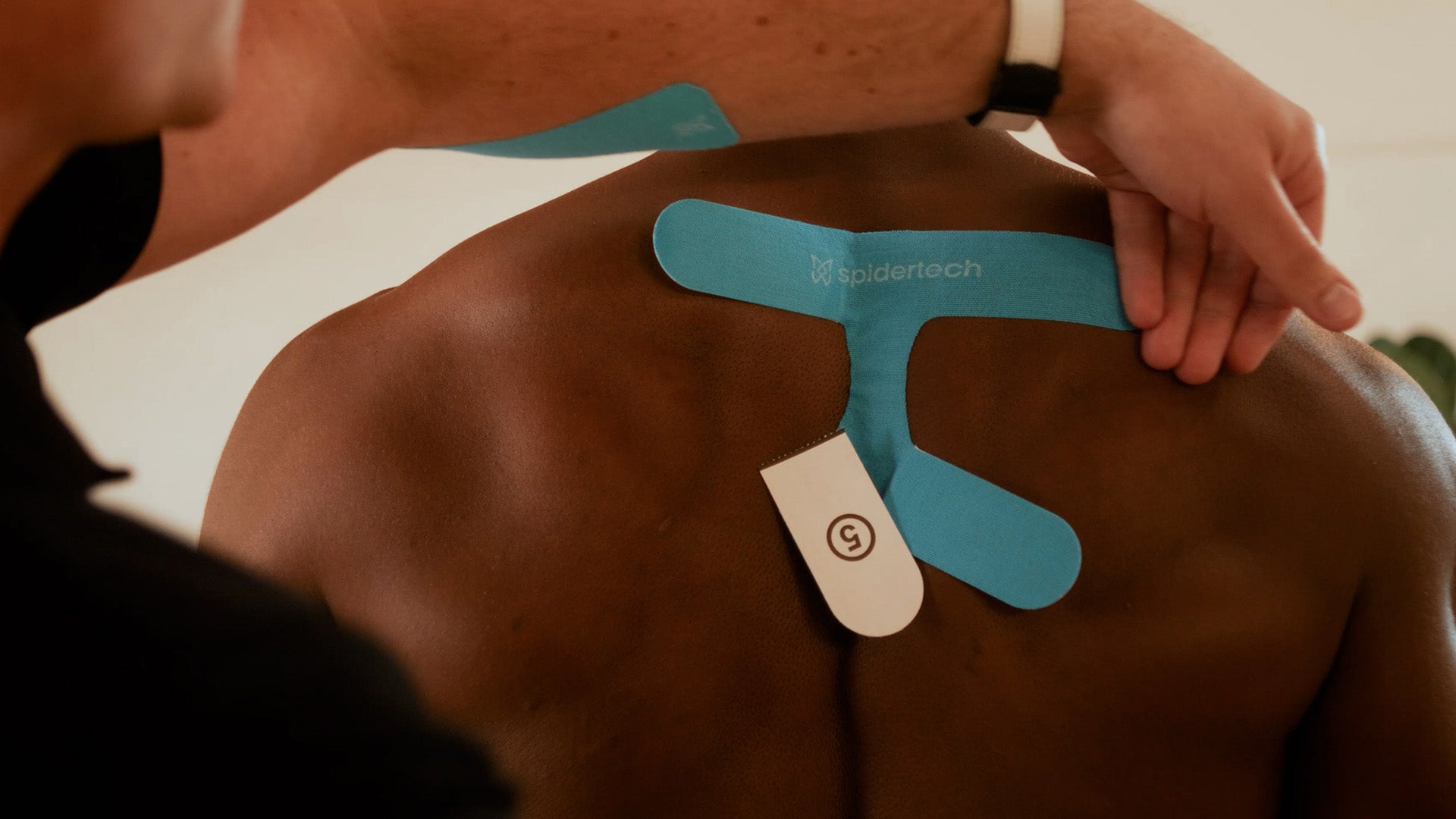
According to a randomized trial in 2025, Kinesiology tape was applied to patients suffering from postural kyphosis, to the upper back muscles. Below is a brief Postural Pro-cut description and illustration of the method:
1. The first section of tape is applied to the skin over the spine, between the shoulder blades
2. With arms are the side rotate the palms on the hands to face forward, taking Anatomical Position
3. Apply sections 2 through 5 over the skin, moving away from the spine, perpendicular to the ground
It might help if you have a friend or family member apply the tape the first couple of times. In this way, you can gain a sense of the placements and repeat it later with a mirror.

Combining Kinesiology Taping & Stretching For Better Posture
A combination of stretching and kinesiology tape may be a powerful duo worth considering for your posture. As recently shown for the 6-week daily wear of kinesiology taping over the upper back, an improvement in forward slouching posture was evident.
One explanation for improving posture was that kinesiology taping enhanced proprioceptive sense and awareness. Another was a change in pectoralis minor muscle length. Such insight can paired with previous research findings.
A few studies support that stretching the pectoralis minor can also lengthen the muscle and decrease forward shoulder posture. So, how you kickstart your journey to better posture and easier breathing can be done in multiple ways or a mighty combination.
Learn More
Our comprehensive Skool platform covers taping techniques as well as free webinars that go over taping efficacy. Sign up for free and start taking advantage of our courses.
References:
- Sports Performance and Breathing Rate: What Is the Connection? A Narrative Review on Breathing Strategies
- The effects of shoulder stabilization exercises and pectoralis minor stretching on balance and maximal shoulder muscle strength of healthy young adults with round shoulder posture
- Comparison of scapular posterior tilting exercise alone and scapular posterior tilting exercise after pectoralis minor stretching on scapular alignment and scapular upward rotators activity in subjects with short pectoralis minor
- Kinesio Taping and Postural Correction: Effects on Kyphosis, Chest Expansion, and Quality of Life: Randomized Clinical Trial
Share:
How Long Should You Wear Spidertech Tape?
Combining Spidertech With HIIT: Why They Work Together